
SHARING OUR PASSION FOR HEALTH & WELLBEING
Are children too young to lift weights? The science behind youth resistance training
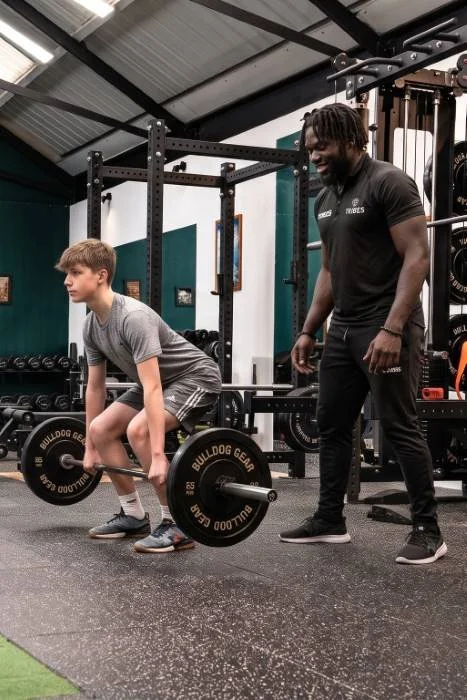

Kinglsey Arthur - TRIBES Coach
27 November 2026
‘Lifting weights will stunt a child’s growth’ is a comment I hear all too often in the fitness community and also by parents alike. I get it, often pre-existing prejudices about lifting and going to the gym have stopped a lot of young people partaking early in resistance training, and the idea of lifting heavy weights and the risk of injuring a young child so early on makes it a difficult concept to buy into.
However, I want to explore what scientific evidence and evidence-based research tell us about the topic.
Will lifting weights stunt a child’s growth?
To understand why this statement exists in the first place, we need to understand the reasoning underpinning this notion. The human skeleton will develop throughout childhood and adolescence.
Epiphyseal plates, commonly known as growth plates, are located in long bones and are responsible for their growth in early life. The misguided concern around resistance training largely stems from the idea that mechanical loading on epiphyseal plates possibly reduces their effectiveness or compresses growth completely.
How bones adapt to resistance training
Bones will adapt to mechanical loading; the body is very complex and develops in many special ways. The principle of Wolff’s Law best describes this (1); to put it simply, the skeleton will respond to the demand placed on it in order to better manage that demand.
Just like with muscles, when introduced to mechanical stimuli, bones, over time, will adapt, increasing the bone's density and mineral content through a process called bone remodelling.
For example, a young athlete squatting in a gym will produce muscular force, which will load the skeleton. This force is the stimulus bones use to adapt to the demand to perform a squat effectively.
It is not as simple to say that more resistance = more loading = bigger, stronger bones; in fact, poorly managed and misguided training sessions can increase the risk of injury to epiphyseal plates. Hence, clear, guided and structured practice and education about resistance training for young individuals is vital to ensure they benefit the best.
Research shows that structured resistance training deep-rooted in foundational strength and movement patterns has no effect at all on growth plate activity or any sort of developmental growth on young people (1), highlighting the importance of us, as experts, planning and delivering structured, safe and foundational programmes for all types of people and, through this, diminishing the notion of resistance training being this unsafe and injury-prone practice.
Why strength training matters for young athletes
I want to emphasise how resistance training is a founding contributor to long-term athletic development (LTAD). Developing a young person’s physical strength is not just lifting heavy weights but building those physical connections and foundations required for athletic movement.
With my own experience being a recreational athlete coupled with my own coaching practice, I have seen firsthand the improvement in athletic performance resistance training can have on the transferable skills required for sport or for just general health.
Specifically, when done effectively, it can have lasting impacts on development into adulthood, strengthening problem areas such as the erector spinae muscles (lower back), traps and shoulders which are all too commonly ignored.
Strength and conditioning for young people takes deliberate planning and consolidation, especially here at TRIBES, where we don’t train them as mirrors of adults but for sport-specific training or for foundational muscular strength (2).
Resistance training for young people can help improve:
Muscular strength and development
Core stability
Muscle-mind connection
Athletic development and performance
These are just some of the physical benefits associated with introducing young people to structured resistance training.
Why children shouldn’t train like adults
Every young child matures differently - physically, mentally and emotionally - so their individual needs relating to physical fitness should always be tailored to them.
Two young people will show very different levels of strength, coordination and skeletal development. In particular, with adolescence, a 14-year-old who has already had a growth spurt will require a whole different approach to training than another 14-year-old who has yet to have their growth spurt.
The fear that young people are more prone to getting injuries while resistance training at gyms is very prevalent but should be mitigated very easily.
Young people shouldn’t train like adults, especially pre-teens. Exercises should focus on foundational strength and movement patterns, including:
Squatting
Hinging
Pushing
Pulling
Lunging
Carrying
Core bracing
Controlled jumping and landing
Most importantly, structure with guided practice is needed, not young people using social media influencers as a replacement for a professional guide, and parents not allowing their children to partake in long-term athletic development.
It’s about more than physical strength
This is not to say that every young person who takes part in resistance training should take part in sport. However, other than just physical benefits to resistance training, there is an importance to establish an active lifestyle during childhood.
Physical activity extends beyond just athletic performance in young people; it moulds their social development and emotional wellbeing.
The latter is something particularly important to me, as being a teacher myself, I am seeing far too many young people engrossed in the world of technology and are unaware of their outside environment.
I see firsthand how a lack of physical activity affects their communication, teamwork, drive, discipline and care for their life outside of social media. I believe, as a coach, it is my responsibility to get young people to become stronger, but to also shape their future by educating them and those around us with the unseen benefits physical activity can have on them and how it can positively impact their future.
Sport England states that only 49.1% of young people aged 5-16 in England met the recommended physical activity level. The average recommendation is 60 minutes of moderate to vigorous physical activity per day every week (3,4).
These facts highlight the importance of resistance training being a core factor in shaping a young person’s lifestyle and the need for us, as coaches, to educate and plan structured plans for young people; they should not be training like adults but should be developing their foundational strength and movement patterns.
The TRIBES approach: Building foundations for life
The question should not be as simple as whether children are old enough to lift weights, but how can the appropriate guidance, programming and supervision be best given to ensure we allow for healthy adaptations to resistance training to take place.
Resistance training should not be about chasing 1 rep maxes or mirroring adult programmes.
Looking at how TRIBES ran our weekend bootcamp would be an excellent example of what the structure and intention behind resistance training for young people should look like.
Foundational and functional movements planned with purpose and fun were the goal for the sessions, and considering the success, we were able to put our evidence-based research into practice.
As a coach, I believe the success of youth strength and conditioning should not only be measured by just athletic and physical improvements, but also by increasing their social skills, teamwork, confidence, physical literacy and relationship with exercise.
I implore young people to do detailed research on how best to follow a safe and deliberate resistance training programme with a professional if you have the capabilities, and parents to consider letting your child partake in physical activity with a professional in order to help benefit their healthy, active lifestyle.
References